
Wading Boots: Tying for Stability
Fit matters — but how you lace your boots is just as important. In fact, when wading, your wading boot is an important safety tool, second only to a PFD (personal floatation device). Not to mention, performance is a key benefit of choosing a wader/boot combo over an all-in-one wader.
When it comes to wading boots, instability on the water isn’t always caused by the sole — it’s most often caused from movement of the foot inside the boot, and that’s often caused by poor fit or worn and stretched out boots. Tying your boots properly can help keep your foot stable.
The goal is to lock your foot in place without restricting circulation.
The Facts
A firm fit is important for women’s balance and stability.
Women’s ankles aren’t necessarily weaker than men’s, but hormonal differences can make ligaments more lax. Because of this, many women assume that tightening — or even “choking” — the ankle will improve stability. In reality, it does the opposite.
There’s a common belief that a snug boot reduces circulation, but the bigger issue is actually over-tightening around the ankle. That’s where restriction happens. Gentle, even compression through the foot can actually help reduce swelling and improve stability, however, excessive pressure at the ankle can interfere with blood flow.
Women’s calves often extend lower into the ankle area, meaning there is less separation between the calf muscle and the structures of the ankle. Over-tightening in this region can place pressure on:
veins that return blood to the heart
arteries that supply blood to the foot
nerves & muscles responsible for sensation and movement
This can lead to discomfort, restricted circulation, and reduced mobility.
The goal is to lock the heel back into the heel cradle, to avoid
toe pressure and banging into toe-cap
foot sliding. forward and back
foot shifting, up and down
Step-by-Step Lacing for Stability
Start with a firm base across the top of the foot
When you lace through the lower section (the flat part across the top of your foot), apply slightly firm, even pressure — not tight, but secure. This helps seat your foot properly in the boot.Tighten aggressively at the ankle bend
This is the most important step.At the point where your foot bends into your ankle, you should tighten as much as you comfortably can. This is what locks your heel into place and prevents sliding.
If this area is loose, your heel will lift — and you’ll lose stability immediately.
Lace casually to the top
From the ankle upward, continue lacing with a secure but relaxed tension.
! Avoid over-tightening this section which can reduce comfort and circulation.
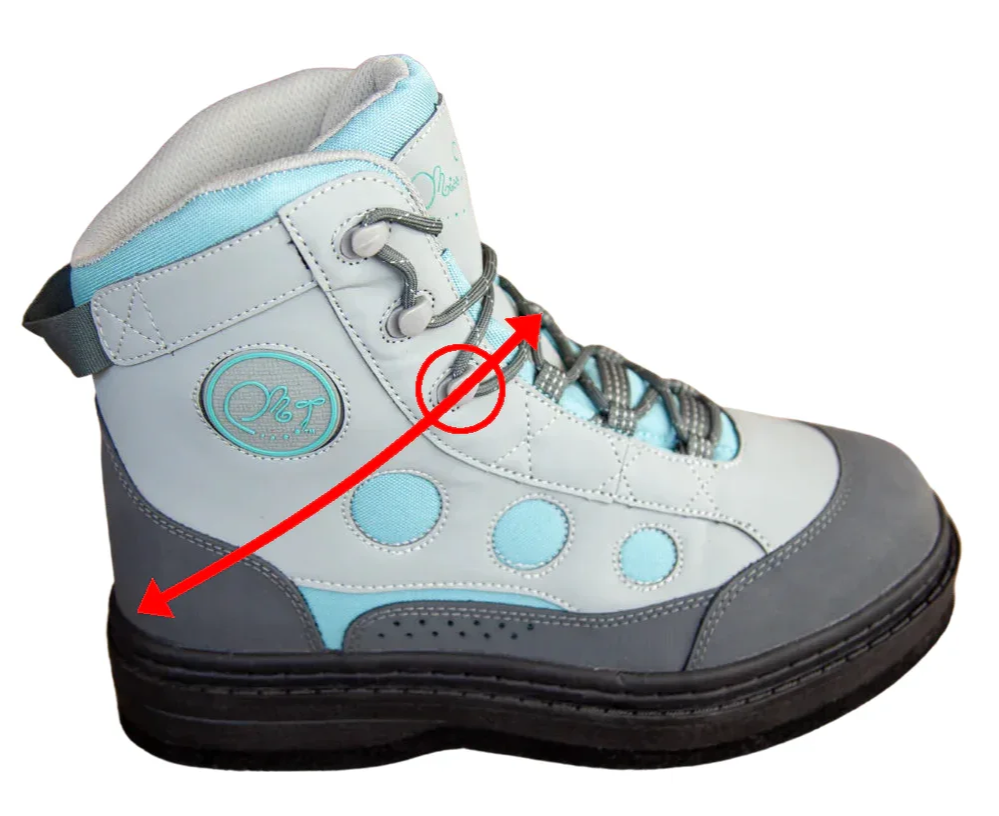
ANKLE BEND- Tie extra tight here
How to Secure Your Laces All Day
Once your boots are tied:
Tie a standard bow
Then take the loop ends and pull them over the top boot hooks or latches on each side
Pull the loose ends snug
Tuck any excess into the top of the boot
This simple step helps keep your laces from loosening throughout the day — especially when wet.
To Learn More:
Listen to episode 3
Read blog “Wading Boot Fit”
Join our community conversation
References
-
National Institutes of Health (NIH)
https://www.ncbi.nlm.nih.gov/pmc/articles/PMC3435910/ -
Journal of Sports Sciences – Footwear and stability research
https://www.tandfonline.com/toc/rjsp20/current -
Cleveland Clinic https://my.clevelandclinic.org/health/body/21573-foot
-
Harvard Health Publishing
https://www.health.harvard.edu/staying-healthy/compression-stockings
